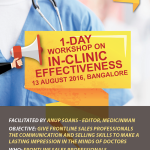
There was a phase when the industry feared that digital would eventually replace the medical sales representative but it appears that digital engagements work best when facilitated by an affable and knowledgeable person, who can personalize the information, and the conversation, to the doctor. In pharma, there’s no substituting face-to-face dialogue it seems. And why should it?
“Rather than digital replacing a person in pharma, the need of the hour is digitalizing the approach of person. The person and the technology are HERE TO STAY”, says Archis Joshi, Commercial Head at Dr. Reddy’s.
The sales role is getting tougher. Medical information, at one point pharma’s greatest value, is today much more freely available than it used to be. In the Indian market which is dominated by generic medicines lacking differentiation, simply informing doctors about the product, isn’t a viable prospect any more when it comes to piquing their interest.
“Why are brands that have been around for some time still unable to cross the marketing funnel and are still stuck at either the ‘awareness’ or the ‘interest’ stages, and unable to move towards the ‘purchase’ or ‘recommendation’ stages?” wonders Mehul Shukla, Director, Marketing Excellence at Cipla.
If a business fails, it was an idea that didn’t work. If treatment fails – it must be a botch up. A broken gadget may be beyond repair, but not a patient in a doctor’s hands. From such ungraded expectations stems the potential for things to take an ugly turn.
An unwanted profession dealing with an unwanted condition, namely Ill health:
If possible, we would wish away death and diseases, hospitals and doctors. A hospital is not a holiday resort, but it too costs money. And the scenario of an adverse outcome like death simply becomes unacceptable.
DigiStorm 2018 was held on 11 September at the Lalit Ashok in Bangalore. The event was headlined by Prabir Jha – President & Global Chief People Officer, Cipla. Deep Bhandari – Editorial Board Member, MedicinMan, gives us the highlights of the post-lunch session.
Is Pharma’s business model like McDonald’s? Doing things over & over again without innovation?
McDonald’s is famous for its Hamburger University, a training facility at the McDonald’s Corporation global headquarters in Chicago, Illinois. It instructs high-potential restaurant managers in restaurant management.
More than 5,000 students attend Hamburger University each year and over 275,000 people have graduated with a degree in Hamburgerology.
Sound familiar? Pharma’s training has been on similar lines – hire people continuously and put them through the grind of mugging up essentials of drugs for diseases that the particular company sells.
While the McDonald’s model is ideal for its business of replication, it has outlived its utility in healthcare and drug companies are in danger of being reduced to mere suppliers of drugs to new digital platform businesses unless they learn to innovate.
It is the twentieth anniversary of the new patent act in January 2025. The post-patent (P20) era is a story of resilience, determination, and charting a course that set global ambitions, a story of finding opportunity in adversity. It is a story for case studies in business schools, in international studies, in global health efforts.
“If we look at major trends, people are living longer, on average, so there’s a rise in chronic diseases associated with aging. Meanwhile, healthcare workers are in short supply, and physicians and nurses do not have enough time for patients. Yet everyone has powerful computers in their pockets that give them access to technology, education, and information. Put all that together, and it’s the perfect moment for digital solutions to come to the market, change behavior, and enhance health outcomes at scale”
- Bozidar Jovicevic, Global head of Digital Therapeutics, Sanofi